
Analysis of mechanical properties of fiber reinforced concrete
Article Sidebar
Main Article Content
Abstract
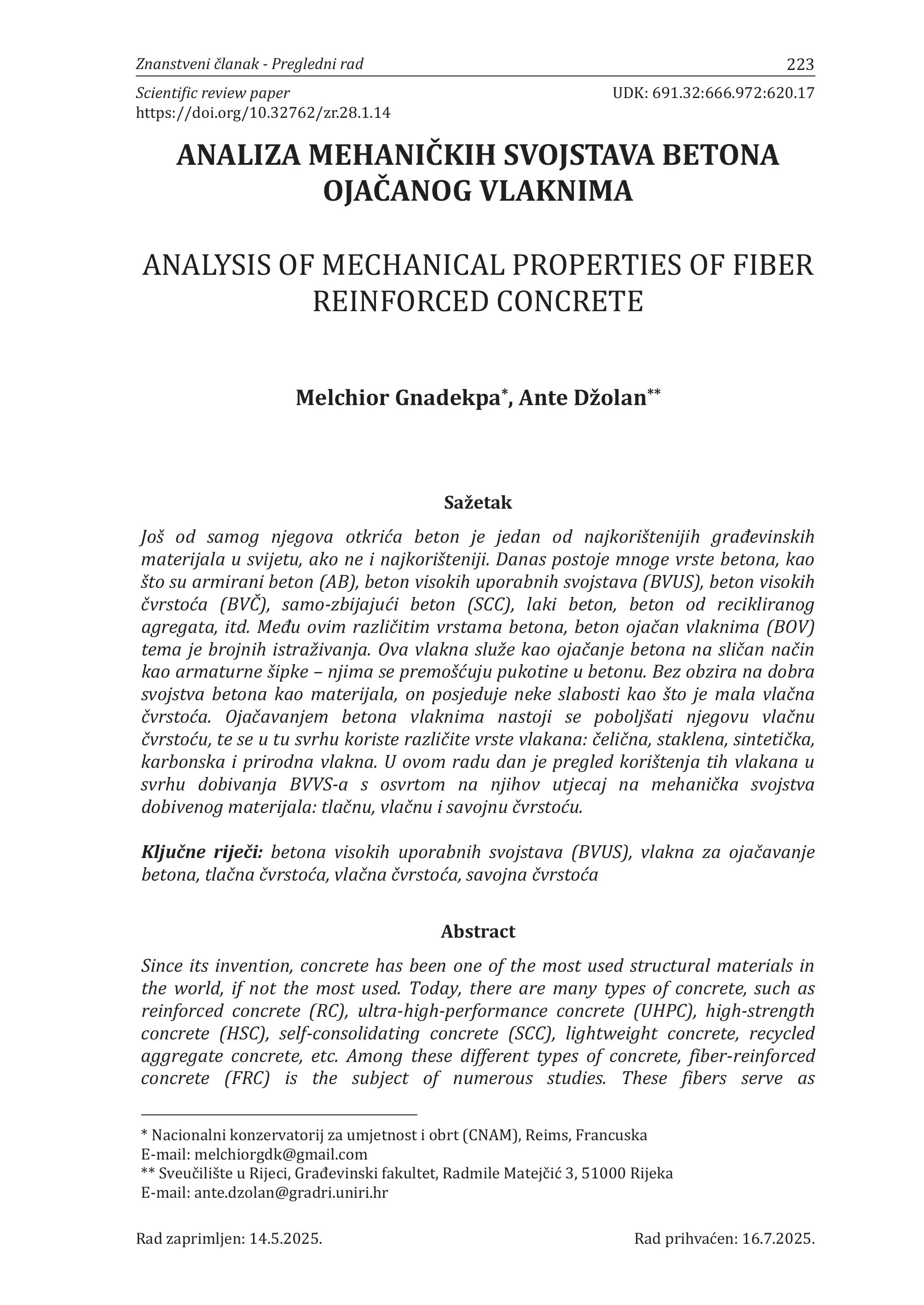
Since its invention, concrete has been one of the most used structural materials in the world, if not the most used. Today, there are many types of concrete, such as reinforced concrete (RC), ultra-high-performance concrete (UHPC), high-strength concrete (HSC), self-consolidating concrete (SCC), lightweight concrete, recycled aggregate concrete, etc. Among these different types of concrete, fiber-reinforced concrete (FRC) is the subject of numerous studies. These fibers serve as reinforcement of concrete in a similar way like reinforcing bars – they bridge cracks in concrete. Regardless of the good properties of concrete as a material, it has some weaknesses such as low tensile strength. Reinforcing concrete with fibers aims to improve its tensile strength. Different types of fibers are used for this purpose: steel, glass, synthetic, carbon and natural fibers. This paper provides an overview of the use of these fibers for the purpose of obtaining UHPC with a focus on their influence on the mechanical properties of the resulting material: compressive, tensile and flexural strengths.
Article Details
Section
The content of the journal is available in its entirety without fees. Users can read it, download it and share it with other parties on the condition of correctly citing the original, not modifying or in other way utilizing material for commercial purposes, and using the material in accordance with CC BY-NC-ND license of Creative Commons (CC) licenses.